How to Make More From a Local Newsletter Without Growing the List

To make more from a local newsletter without adding subscribers, sell what makes the list worth paying for: everyone on it lives in the same place. Sell sponsors longer commitments instead of one-off slots, price exclusivity and reuse rights separately, pitch the regional and national companies that need your town, and give your most popular section its own sponsor. Growth still helps. It just isn't the only lever.
The rest of this post is how to pull each lever without wrecking the issue readers signed up for.
Your list is concentrated, and that's the product
To a national advertiser, 3,000 readers scattered across the country is a small buy. To a business that serves one county, 3,000 readers who all live in that county are 3,000 people it could serve.
Local businesses already pay for this. The dentist down the street can buy search ads that only show to people within a few miles of the office, because Google Ads lets advertisers target a radius around an address. Your list is that radius, except every person on it chose to be there.
So stop pricing like a small national list. Price on geographic fit. It's the same reason a 50,000-person town can be a better media business than a national niche.
Sell longer terms to the sponsors you have
If you sell one placement at a time, every week starts at zero. You resell the same inventory, chase the same five businesses, and spend Tuesday writing invoices instead of the issue.
Fix the sales math before you fix the list. A sponsor who buys a season is usually worth more than three sponsors who buy once, even at a discount.
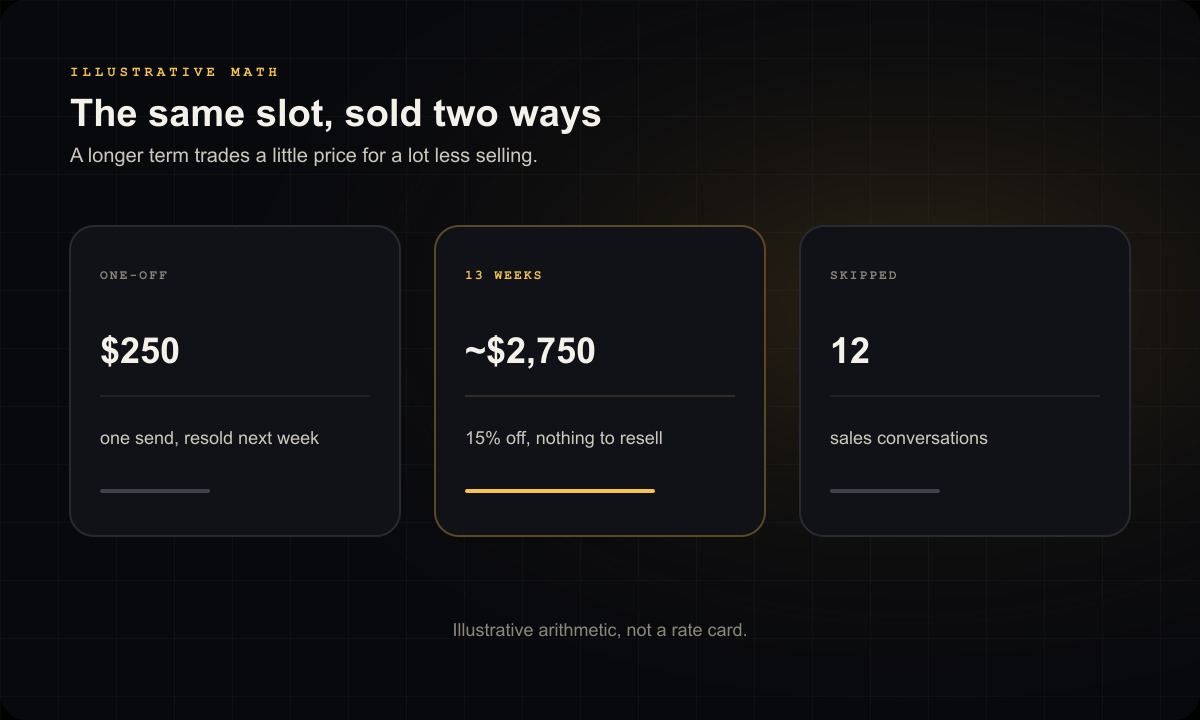
Here's the arithmetic, as an illustration rather than a rate card. A $250 weekly slot sold once is $250. The same slot sold to one sponsor for 13 weekly sends at 15 percent off comes to about $2,750 you don't have to resell. You gave up roughly $500 of list price and skipped twelve sales conversations.
The LocalTrophy sponsor guide already recommends four-issue packages at 10 to 15 percent off. Treat that as the starting point. Once a sponsor has renewed a month, offer a quarter. Once they've renewed a quarter, offer the year.
Make the longer deal easy to say yes to:
Set the renewal date when you sign, not when the term runs out.
Let them swap creative every month so the ad doesn't go stale.
Send a short mid-term report with what you can honestly measure.
Trade the discount for a longer term, never for nothing.
Longer commitments also make next quarter predictable. If six of your eight slots are booked through March, you can plan the issue, the budget, and your own hours around money that's already promised.
Price each part separately
A "sponsored placement" is often three or four things bundled together and sold for the price of one. Pull them apart and price each:
Category exclusivity. If a realtor wants to be the only realtor in the newsletter for three months, you're turning away every other realtor for that time. Charge for it, and charge less for a shorter window.
Reuse rights. If a sponsor wants to run your write-up on their site or in their own ads, that's extra value you created. Price it by how long and where they'll use it.
Extra channels. A social post, a listing on your website, a mention at your event. Each has its own value, so each gets its own price.
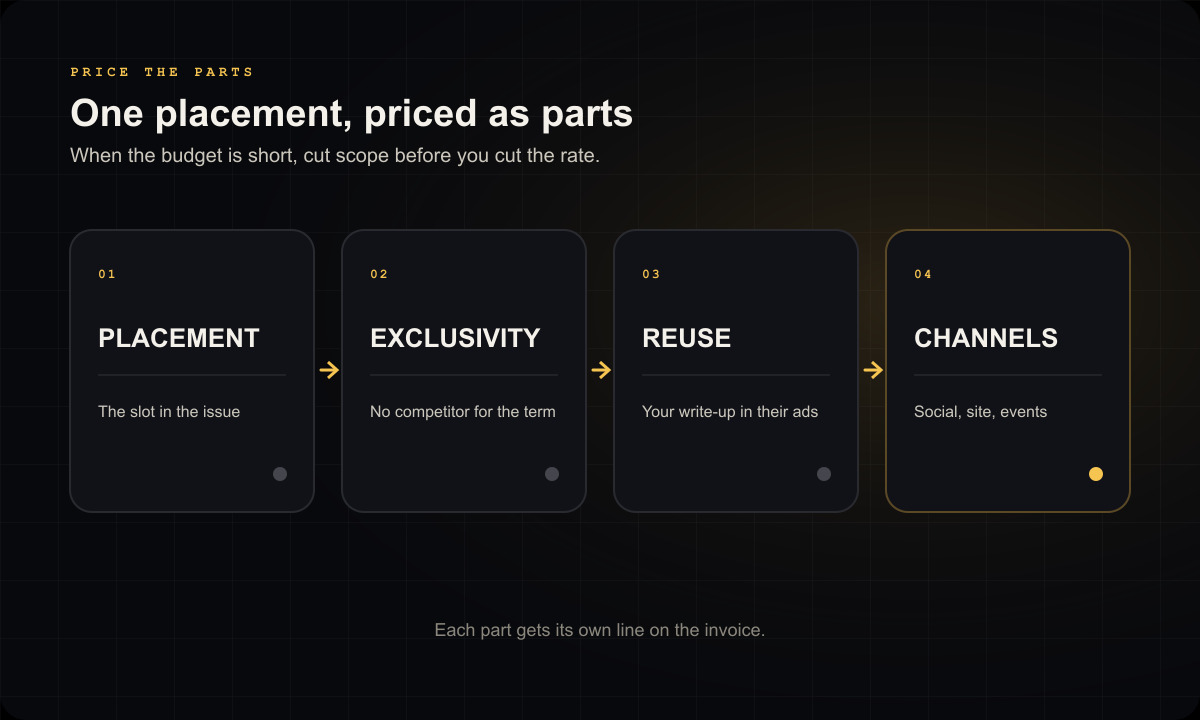
Pricing the parts also protects your rate. When a small business says you're too expensive, don't cut the price. Cut the scope: fewer sends, no exclusivity, a shorter term. The sponsor still gets in, and you don't have to explain to next month's sponsor why last month's paid less for the same thing.
Keep every paid piece labeled, including anything a sponsor reuses. The FTC's native advertising guidance says disclosures have to be clear and prominent, and it names "Ad," "Advertisement," "Paid Advertisement," and "Sponsored Advertising Content" as labels people understand. "Presented by" in light gray at the bottom isn't what the guide means by clear and prominent.
Pitch the companies that need your town
Local newsletters don't have to sell only to local businesses. Your readers bank, fly, see doctors, buy cars, pay utility bills, and send kids to college. The companies behind those decisions often sit outside your town, and they often have bigger budgets than anyone on Main Street.
The best prospects have a specific reason to want your town right now:
A regional hospital system opening a new clinic.
A bank or credit union launching a branch.
A home builder selling a new subdivision.
An airline adding a route out of your airport.
A state tourism or public health campaign aimed at your region.
Find them the same way you find news. Watch permits, branch openings, job postings, and who's buying billboards and radio spots in your market. If a company is already paying to reach your town, your pitch is one sentence: here's a more direct way to reach the same people, who asked to hear from you.
Expect to deal with an agency, not the brand. That can work in your favor. One agency often buys media for several brands, and if you're easy to work with (clean reporting, on-time sends, no surprises), one relationship can turn into more than one client. Keep a list of every agency contact you've worked with, and check in when each campaign ends, not only when you need a sale.
Give your best section its own sponsor
Every newsletter has a section readers would miss most. The weekend events list. Restaurant openings. Home sales. High school sports. You can find yours in what gets clicked, replied to, and forwarded.
When one section clearly carries the issue, don't make the main issue longer around it. Spin it into its own product with its own send and its own sponsor. A home sales send is often easier to sell to a realtor than a general slot, because the fit doesn't need explaining. A restaurant group wants the dining send, not the city council recap.
You get new inventory without touching the core issue. Readers who only want weekend plans can sign up for just that, which may bring in people the main issue never reached. The sponsor gets an audience sorted by interest on top of geography.
Start with one spin-off, one sponsor, and a set number of sends. The LocalTrophy list of content ideas is a good place to spot the section most likely to stand on its own.
When readers will pay instead
Sponsors aren't the only buyers. Some readers will pay for a membership or chip in as voluntary support.
That only works when you offer something they can't get elsewhere. Nobody pays for an events list that's already on the city website. People do pay for original reporting on the school board, a restaurant guide that isn't a list of advertisers, or the only place that explains what's going up on that empty lot. If you can't name what readers can't get anywhere else, don't build a paywall yet. The LocalTrophy monetization guide has planning ranges for what paid tiers can bring in.
When someone does pay, ask why. Put one line in the receipt or thank-you email, written the way you'd say it: "What made you support us today?" The reason is still fresh when the receipt lands, and the reply takes them ten seconds.
Read every answer. Look for the words and reasons that repeat. Those go into the next support drive, because they're the reasons that moved real readers to pay.
Run the numbers before you change anything
Before you raise a price or pitch an agency, write down what you earn now. Use the formula from the 10,000-subscriber math: sends, times slots per send, times sell-through, times the price you actually collected.
Then pick one lever and move it for a quarter:
Reselling the same slots every week? Sell longer terms.
Sponsors keep asking for discounts? Price the parts.
Every local business that fits is already sponsoring? Pitch the regional companies and their agencies.
One section gets most of the clicks and replies? Give it its own sponsor.
Run the same formula at the end of the quarter and compare.
If you'd rather spend your time selling sponsors than writing issues, LocalTrophy can source, write, and edit the newsletter while you own the relationships.
FAQ
Do I need more subscribers before I can charge more?
Not always. If you're reselling one-off slots every week or giving discounts without getting a longer term back, you can raise revenue before the list grows at all.
What should I charge for category exclusivity?
There's no standard rate. Price it as its own line item, scale it with the length of the exclusive window, and remember you're turning away competitors for that time.
Will national brands really buy a small local newsletter?
Some will, when they have a clear reason to reach your town, like a new location or a new route. Most buy through agencies, so expect a longer sales cycle and requests for clean reporting.