The Local Newsletter Math: What 10,000 Subscribers Are Actually Worth

Ten thousand subscribers can produce $200 a month, $3,000 a month, or a loss. The number becomes useful only after you add active readers, sends, sponsor slots, sell-through, collected price, and cost.
Until then, 10,000 is a handsome database row count.
Walk the list down to people who notice
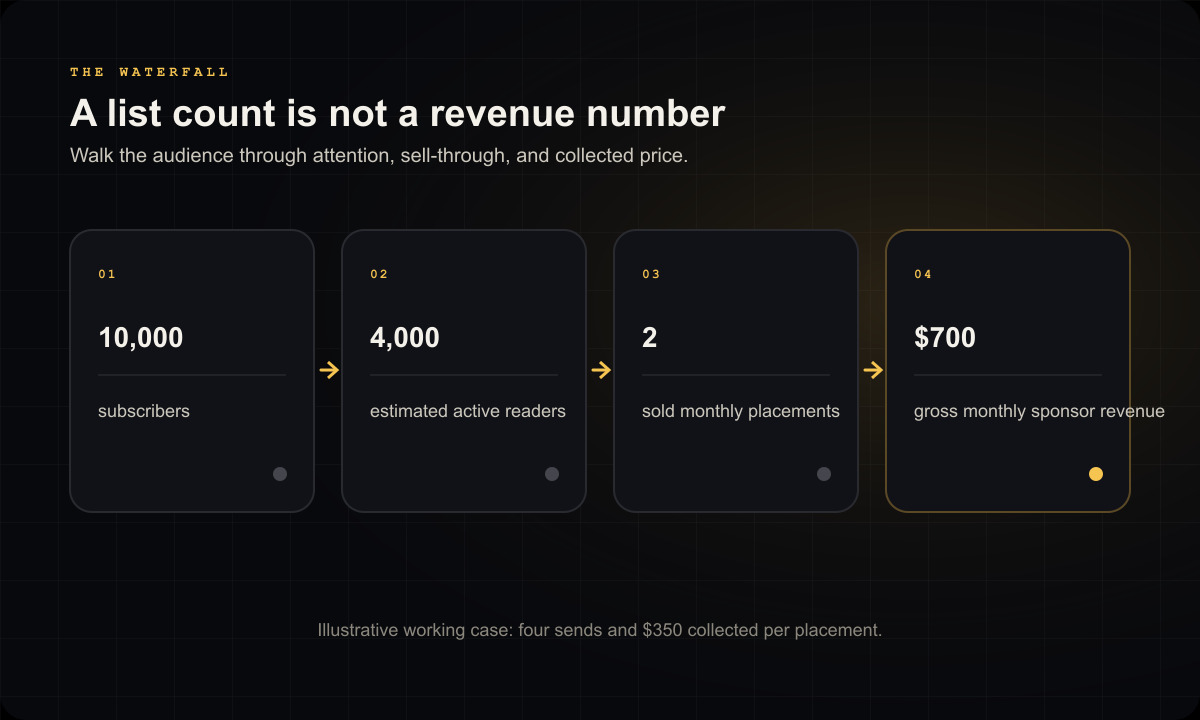
Use your own engagement data. If 40% of a 10,000-person list opens a typical issue, you have 4,000 estimated opens. If the rate is 50%, you have 5,000.
Neither percentage is a promise, and opens are not a certified audience count. Privacy features blur them. Put opens beside clicks, replies, survey answers, sponsor redemptions, and direct traffic. You are trying to estimate how many people reliably notice the product.
That is the audience a sponsor may value. The other addresses still matter for reactivation and future issues, but they do not deserve equal weight in a pricing model.
LocalTrophy's guide to local newsletter revenue shows how earnings change across list sizes. Here, we will hold the list at 10,000 and move the inputs everybody tends to hide.
Inventory is not revenue
A weekly newsletter with one sponsor slot creates about four placements a month. If half sell at an average collected price of $350, monthly sponsorship revenue is $700.
A five-day publication creates roughly 20 primary placements. If six sell at $250, monthly revenue is $1,500. The other 14 are not "available revenue." They are empty rectangles.
Use this formula:
monthly sponsor revenue = sends × slots per send × sell-through × average collected price
Collected price means the invoice after discounts, bundles, and make-goods. Your rate card can say $500. If sponsors routinely pay $325, use $325.
The LocalTrophy sponsor guide covers packaging and pricing. This sheet should be much less charming. It needs sold slots, money received, and renewals.
Three versions of the same list
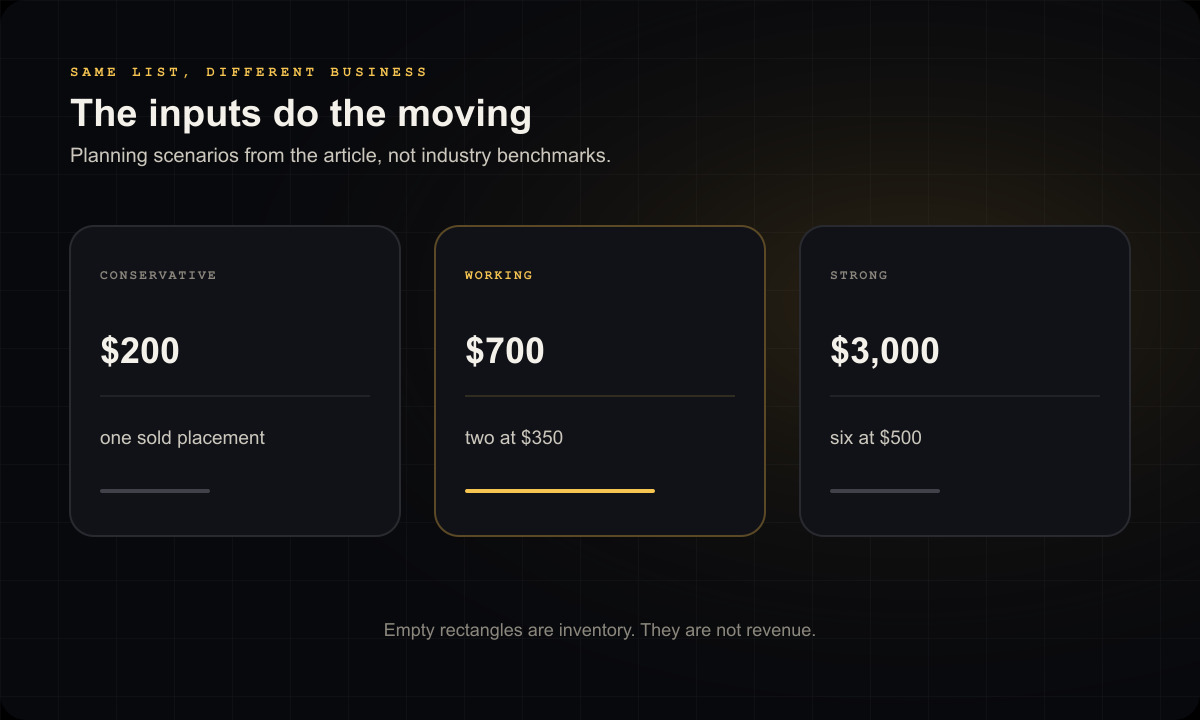
These are planning scenarios, not industry benchmarks:
Conservative: 3,000 estimated active readers, four monthly sends, one sold placement, $200 collected. Gross monthly sponsor revenue: $200.
Working: 4,000 active readers, four sends, two sold placements, $350 collected each. Gross: $700.
Strong: 5,000 active readers, eight sends, six sold placements, $500 collected each. Gross: $3,000.
The subscriber headline never changed. Sales capacity, attention, frequency, and price did all the moving.
The middle case is where many operators live. There is enough audience to interest sponsors, but selling every week takes time. A founder who can close two placements may not magically close eight after adding a second weekly send. Editorial inventory can grow faster than the sales pipeline.
CPM helps you compare, then gets out of the way
If a placement costs $250 and produces 5,000 estimated opens, its open-based CPM is $50. That is arithmetic, not a declaration that $50 is the correct market rate.
A sponsor trying to reach homeowners in one service area may value the fit. A restaurant with a weak offer may not get results at half the price. Position, creative, category, exclusivity, and measurement all matter.
Use CPM to compare packages and catch obvious pricing mismatches. Then use sponsor outcomes and renewals to set the next price.
Subtract the Sunday afternoon
Imagine the strong scenario collects $3,000. Writing and editing cost $700, sales and sponsor handling cost $350, software and data cost $150, and payment fees plus other direct expenses cost $100. Contribution before overhead and tax is $1,700.
If you do the work yourself, the cost does not become zero. Record owner hours and decide what that time must earn. Thirty hours a month for $700 in gross revenue may still make sense if the newsletter generates clients for another business. It is not automatically a good standalone media company.
The LocalTrophy monetization guide describes other revenue streams. Add them when demand appears. Sponsorships, memberships, events, affiliate offers, paid guides, and merchandise entered in six spreadsheet rows do not count as diversification.
Decide what the list is meant to do
A real estate team may use the newsletter to generate listings. A chamber may want event attendance. An independent publisher may need sponsor margin. Keep those outcomes in separate columns.
Three thousand readers who match the business can be worth more than 10,000 people acquired through a broad giveaway. The useful asset is permission to reach a known local audience with a product they continue to notice.
Track total subscribers, active readers, sends, available and sold slots, collected revenue, direct cost, owner hours, and sponsor renewals each month. Review a three-month trend. One unusually large sponsor can make a single month tell a very confident lie.
If you want to own the audience and commercial relationships without producing every issue, LocalTrophy can handle the sourcing, writing, and editing.
FAQ
How much can a newsletter with 10,000 subscribers make?
The same list can make a few hundred or several thousand dollars a month. Active readership, send frequency, sell-through, collected sponsor price, and other revenue determine the result.
Is a $50 newsletter CPM reasonable?
It can be for a specific local audience, but it is not a universal rate. Use it as a planning input, then price from sponsor results, renewals, and audience fit.
Should I send more often to create more ad inventory?
Only when reader demand, editorial capacity, and sponsor demand support it. More empty slots and thinner issues are not an upgrade.