Why a 50,000-Person Town Might Be a Better Media Business Than a National Niche

A 50,000-person town can be a better first newsletter market than a national niche. You can identify the audience, reach it through local channels, and offer sponsors geographic fit instead of a large pile of unrelated impressions.
It can also be too quiet, too hard to monetize, or already well served. Small is useful because you can inspect the market. It is not useful because every town secretly wants a media startup.
Do not call population your market
A town of 50,000 includes children, people outside your chosen audience, residents who rarely use email, and adults who do not want your product. Assigning yourself a future 20% share because the formula fits one row is optimistic even by spreadsheet standards.
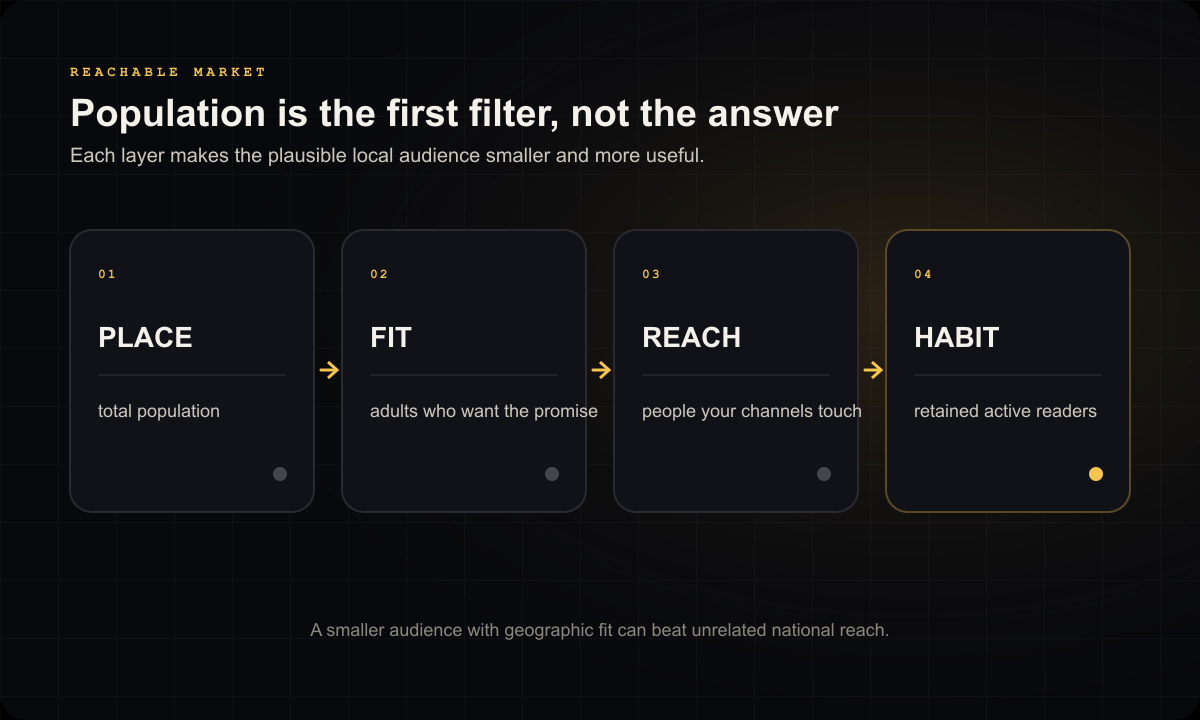
Estimate the reachable market in layers: adults in the geography, people who match the promise, people you can reach through actual channels, confirmed subscribers, and retained active readers.
For illustration, imagine a 50,000-person town with 15,000 adults who plausibly fit and can be reached. A 3,000-person retained list would mean reaching one in five of them. That is a serious local position, not the casual 6% penetration the population figure suggests.
Use your town's real demographic and channel data. The LocalTrophy start guide helps define the place and reader before you start multiplying.
Local sponsor fit is easier to explain
Ten thousand national readers interested in "better living" may live everywhere and buy nothing from the same business. Three thousand readers in one town give a dentist, HVAC company, restaurant group, realtor, or festival a cleaner question: are these the residents we need?
The answer may still be no. The sponsor needs the right category, offer, and budget. But you do not have to explain why most of the audience lives outside its service area.
Before launching, count plausible sponsors. Look at businesses buying local search ads, supporting youth sports, appearing in event programs, and opening additional locations. Then ask whether your reader overlaps their customer.
LocalTrophy's guide to newsletter sponsors covers the sales work after that first market check.
Distribution can happen in the town
A national publisher usually competes for attention through national channels. A local newsletter can grow through the library, a coffee-shop counter, school groups, neighborhood pages, events, and businesses that already talk to the reader.
Those channels are manual. Fine. They only need to work in one place.
A shop owner may share your signup page, send a story lead, and later buy a sponsorship. A farmers-market conversation may produce 15 readers who live exactly where the publication says it serves. The LocalTrophy growth guide covers the unscalable work behind the first thousand. In a small market, unscalable can cover a meaningful share of the audience.
The town also remembers your mistakes
A compact market does not provide an endless supply of replacement readers. Publish wrong opening dates often enough and the owner, customer, and reader may all hear about it before you issue a correction.
That pressure rewards a useful product. The newsletter has to verify details, make choices, and sound like it notices the place. A generic event scrape may collect addresses through a giveaway. There are only so many locals available to ignore issue two.
Reputation travels through the same network as growth. That can build trust quickly. It can distribute disappointment with admirable efficiency too.
National can still be the better choice
A national niche offers a larger ceiling, more potential affiliate products, and freedom from one town's business cycle. If you have unusual subject expertise, a strong search position, or existing national distribution, forcing the idea into one geography may throw away your advantage.
Compare both businesses on the same inputs: reachable audience, acquisition channels, retained-reader cost, sponsor or product demand, editorial cost, and your reason for winning.
The local option should win because the place makes information, distribution, or revenue easier. "There are fewer people" is not a strategy by itself.
Score the town before choosing it
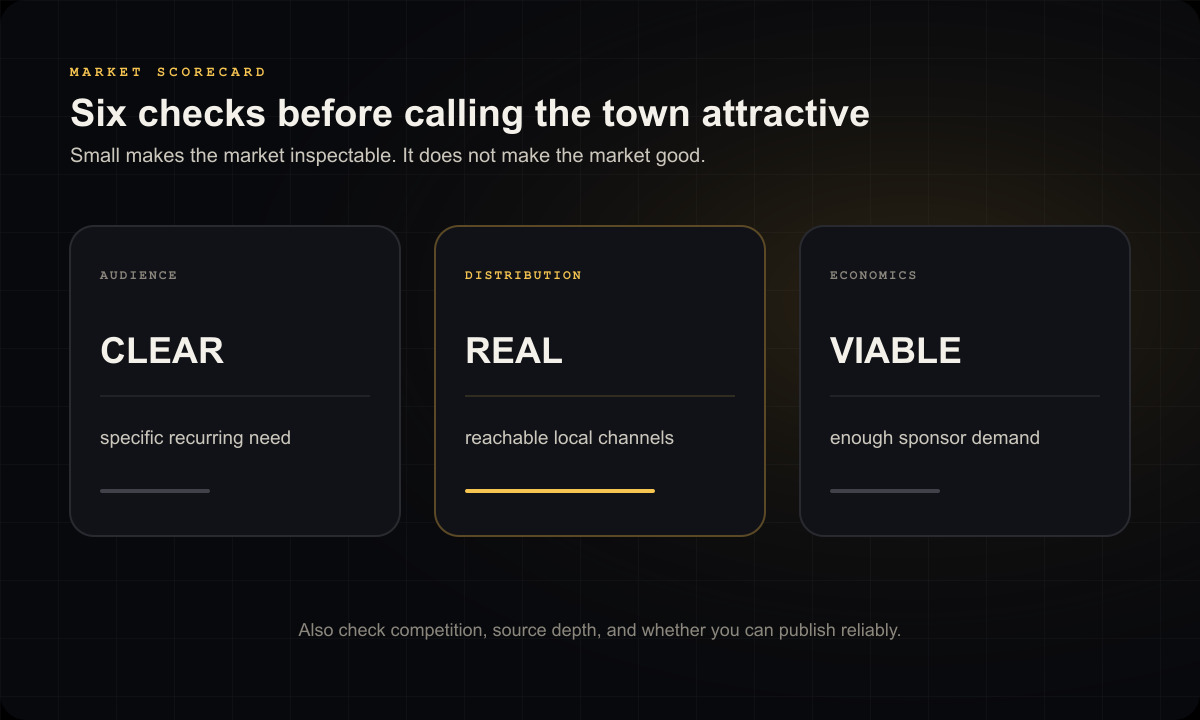
First, confirm there is enough fresh information for a weekly product. Look at event calendars, public agendas, openings, arts, sports, development, schools, and recurring local decisions.
Then test reach. Are the groups active? Will partner organizations share? Do residents attend events where you can appear? Can paid geographic targeting find enough of the audience without exhausting it?
Check sponsor depth and competition together. A strong existing publication proves attention exists but may own the broad promise. A narrower audience can still work if its reader and commercial use are distinct.
Finally, inspect the sources. If basic dates, fees, agendas, and business changes are hard to verify, weekly production will cost more than the tidy market slide suggests.
If the town passes those checks and production is the constraint, LocalTrophy can source, write, and edit the issue while you build partnerships and sponsor relationships.
FAQ
Is 50,000 people enough for a local newsletter?
Yes, when a reachable slice of the town wants the product and enough local businesses value that audience. A few thousand engaged readers can be commercially meaningful.
What if the town is smaller?
Cover a coherent county, nearby-town cluster, or narrower high-value audience. Do not enlarge the map until the promise loses its local usefulness.
Are local subscribers cheaper to acquire?
Sometimes local targeting and partnerships help. There is no guaranteed discount. Compare retained active-reader cost in your market, not raw form fills from somebody else's campaign.