
Build a better newsletter,about anything, anywhere.
LocalTrophy is a done for you service for people who want to build modern newsletters, local and beyond.
A strong local newsletter depends on a lot of invisible work going right.
The right sources. The right story mix. The right pacing. The right voice. LocalTrophy brings that under one roof.
Made to fit your audience
Every audience has its own rhythm. Our sourcing bends to that reality instead of forcing every newsletter into the same template.
Runs like a bigger team
Each issue feels like there’s a serious editorial machine behind it, without you needing to hire a newsroom.
Better picks, not just more
A great send issue isn’t won by stuffing it with filler. It comes from knowing what’s actually worth someone’s time.
See it in action
Get a peek at what makes a localized newsletter great.



The not free part
Launch
- 1 core vertical or editorial lane
- focused source stack setup
- standard issue structure
- 1 voice profile
- AI-assisted drafting
- light human review
- publish-ready copy handoff
Momentum
- up to 3 verticals
- broader source stack
- customized voice
- sponsor slot formatting
- direct ESP-ready delivery
- strong human review layer
Authority
- multiple audience angles
- expansive source stack
- high-touch human review
- premium sponsor support
- full workflow ownership
- strategic planning

Launch a local newsletter people actually open.
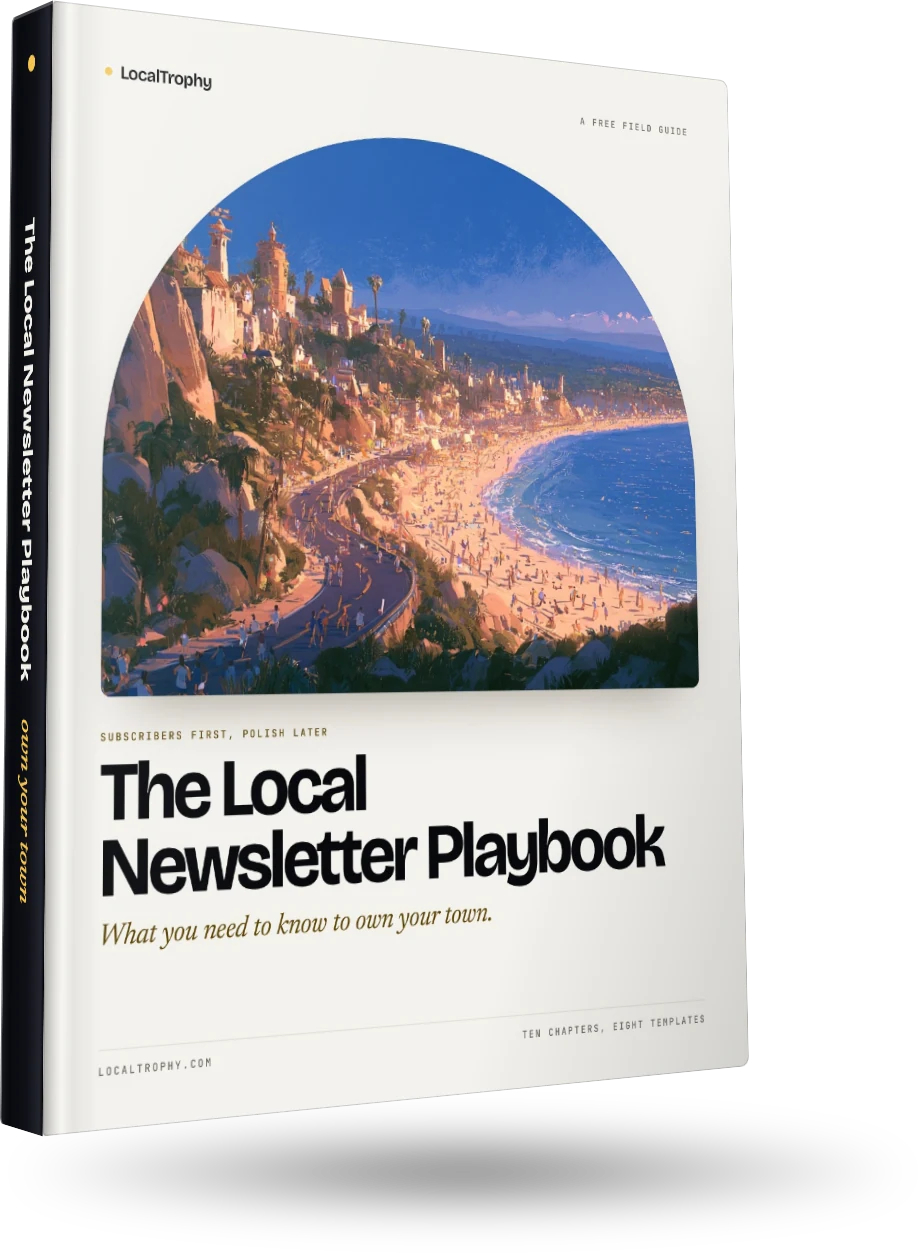
The playbook we'd hand a friend starting from zero: find your first subscribers before you write a word, fill every issue, and land your first sponsor.
- A town scorecard and a day-one launch checklist
- The welcome email and a weekly issue template, ready to copy
- Sponsor rates by list size, plus the pitch email
Instant download, right here.
If your business grows when people in a city know your name, this is for you.
Brands
Become the in-demand weekly read instead of another shop yelling through ads.
Creators
Turn your local culture knowledge into a recurring media asset you actually own.
Agencies
Sell a smarter local product. Scale without hiring a newsroom for every single client.
Operators
Keep your community engaged between touchpoints with the go-to local read.
We build the best local signal layer in your market.
A local newsletter is a media property with direct audience access, sponsorship inventory, and actual commercial value. Done well, it makes you the name people associate with what's worth knowing.
Beyond just content, it's about owning a recurring digital asset. We help you transition from being a participant in a market to the platform that helps define it. This is how you build a long-term media moat around your business or brand.
Stuff you might ask
🏗️What does LocalTrophy actually do?
We build local newsletters from the ground up.
That includes source discovery, story selection, editorial framing, issue structure, drafting, review, and final delivery. In practice, that means we turn a messy pile of local information into a newsletter that feels coherent, useful, and worth opening.
The deliverable is not “content.” The deliverable is a repeatable newsletter product with a real point of view.
🎯Who is this best for?
LocalTrophy is best for people who have a real reason to own attention in a market.
That usually includes brands with local reach, creators with a strong niche, agencies serving place-based clients, and operators building community around a city or scene. The common thread is intent. The best clients already understand that a direct relationship with a specific audience can become a meaningful business asset.
🗺️What kinds of newsletters can you help build?
Pretty broad range, as long as there is a real audience and a clear angle.
That could be a city business brief, a local real estate product, an openings and events read, a founder-focused digest, a hospitality or lifestyle newsletter, or something more niche for a specific type of reader in a specific place. A lot of newsletter formats look similar on the surface. The real difference is in the signal, the framing, and the editorial judgment behind them.
🏢Why wouldn’t I just hire a freelancer or do this in-house?
You can. But this usually three to five jobs pretending to be one.
A good local newsletter needs someone to find the right sources, someone to know what is actually worth including, someone to shape the issue, someone to write it cleanly, and someone to review it before it goes out. Most freelancers can help with one or two of those. Most in-house teams end up cobbling together the rest. That is how you get inconsistency in your craft and newsletters that are either thin, late, generic, or all three.
We built LocalTrophy to compress that stack into one system, more effective and lighter and lighter than hiring a full editorial operation.
⚙️What is the setup fee for?
The setup fee pays for the part most people skip, and then regret skipping.
A good local newsletter is not just a writing problem. It’s a product design problem. Before the first issue goes out, we have to decide what this newsletter is actually about, what signals deserve attention, which sources are reliable, which ones are early, what gets ignored, how the issue should be structured, and what kind of voice fits the audience.
That work becomes the foundation for everything that follows: source maps, editorial lanes, issue architecture, voice rules, workflow logic, and the standards that keep the product from turning into another generic roundup three weeks later.
In plain English, setup is what makes the difference between a newsletter that has a shot at becoming an asset and one that just keeps sending emails.
💰Why does Launch have a setup fee, but the higher tiers do not?
Because the setup work is real either way. We just package it differently.
On Launch, we break it out so the monthly fee stays clean and the scope stays honest. On Momentum and Authority we waive it. The underlying work does not disappear. It is still the same upfront effort to define the product properly.
We would rather be clear about where the value is coming from than pretend everything magically starts with the first monthly invoice.
📊What’s the difference between Launch, Momentum, and Authority?
Launch is for getting one focused concept into market with real quality with clear boundaries.
Momentum is for building a broader, stronger product with more signal, more editorial nuance, and more potential to become a real audience asset.
Authority is for clients who want a more serious media build, where we take on more of the sourcing, shaping, review, and strategic refinement over time.
📡What makes your sourcing better than a smart person with RSS feeds and a few prompts?
Could you just clone the next-best information pool? Sure. Most people can assemble feeds. That is the easy part. The hard part is knowing which sources are consistently useful, which ones are too late, which ones are noisy, which community accounts matter, which patterns are worth tracking, and how to combine all of that into something that gives you a better read than the obvious inputs alone.
We are building source maps, filtering logic, and editorial systems that improve by market, niche, and audience. That is where a lot of the real edge lives. Better inputs, better picks, better final issues.
🤖How do you use AI? I don’t want to pay a company to type into ChatGPT for me.
Fair question in this day and age. AI helps with speed, synthesis, and workflow. It does not replace source quality, editorial judgment, or final review. Everyone ultimately has access to the same tools, but not the way those tools sit inside a stronger system.
We use AI to help process more signal, move faster through drafting, and keep production efficient. But the actual product still depends on what gets sourced, what gets filtered, how the issue is shaped, and what survives human review. That is why the output should feel better than generic prompt-and-publish content.
✨How do I know this won’t turn into generic newsletter sludge after a month?
That usually happens for predictable reasons: weak source variety, lazy filtering, no editorial standards, and no one paying attention once the workflow is live.
We build against that from the start. The source stack is wider. The editorial angle is more defined. The issue has structure. The audience is clearer. And the final product still gets reviewed by a human who can tell the difference between “technically relevant” and “actually worth sending.”
A good newsletter gets stale when nobody is steering it. Part of the job is making sure it keeps getting sharper instead of drifting into autopilot.