The $1 Subscriber: Why Local Newsletters May Have One of the Best CAC-to-LTV Ratios Online

A $1 local-newsletter subscriber can be a terrific buy. It can also be a cheap address that never reads, never clicks, and leaves before a sponsor pays you a dollar. The business works when you measure the second number, not when you admire the first one.
The appeal is obvious. You can target one geography, give residents a useful free product, and sell local businesses access to an audience they already want. Just keep the arithmetic attached to reality.
Your ad dashboard stops too early
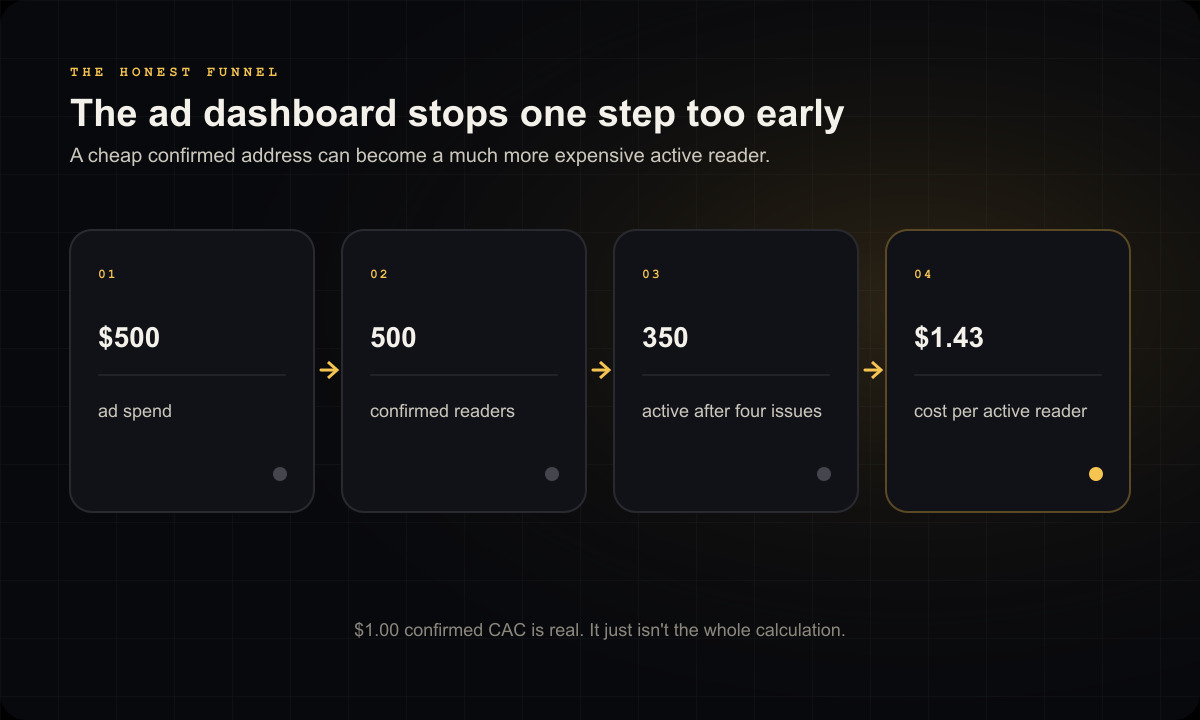
Suppose you spend $500 and get 500 confirmed subscribers. The campaign reports a $1 CAC.
Four issues later, 350 of those people have opened or clicked at least once. Your cost per active reader is $1.43. Nothing went wrong. You simply stopped counting at the point where the ad platform felt most flattering.
Track both figures:
confirmed-subscriber CAC = ad spend ÷ confirmed subscribers
active-reader CAC = ad spend ÷ subscribers who meet your activity rule
Set the rule before the campaign. Open data is noisy, so use something practical, such as an open or click during the first four issues. The measure will not be perfect. It will still be more honest than valuing an untouched inbox address like a Thursday regular.
LocalTrophy's guide to growing a local newsletter covers the channels that can produce those first readers. Whichever channel you use, tag the cohort.
The clean $12 story needs a second page
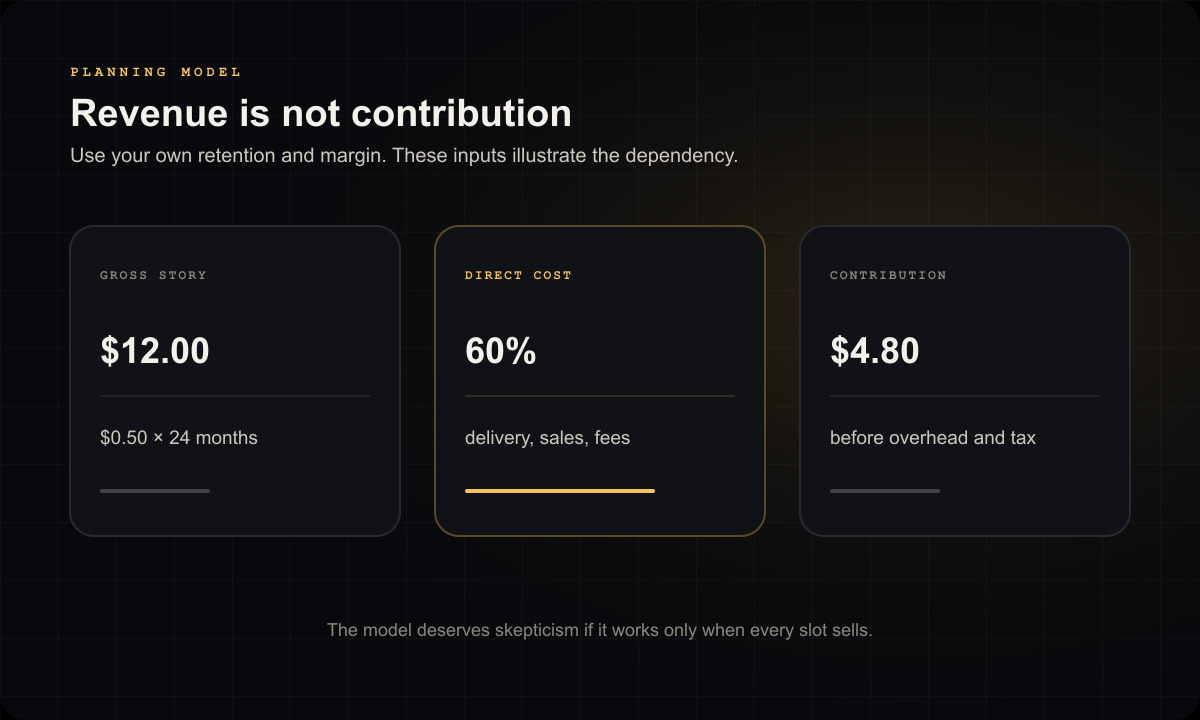
Here is the attractive version. A subscriber produces $0.50 a month in sponsorship revenue and stays for 24 months. Gross lifetime revenue is $12.
Now include the things the headline left outside: unsold placements, sponsor discounts, sales time, writing, software, payment fees, and the readers who disappear in month three. If direct costs consume 60% in this example, the $12 becomes $4.80 of contribution before overhead and tax.
That can still be excellent against a $1 acquisition cost. Against a $4 active-reader CAC, there is almost no cushion for a weak sales month.
Use this planning formula:
contribution LTV = monthly revenue per active reader × active months × contribution margin
The inputs are yours. The submitted $0.50 and 24 months are a scenario, not a LocalTrophy benchmark and not a number you should paste into a pitch deck before observing your own retention.
A cohort makes the dependencies visible
Take those 350 active readers. Imagine the newsletter earns $140 in additional collected sponsorship revenue each month after the cohort arrives. That is $0.40 per active reader.
If direct delivery and sales costs leave a 50% contribution margin, monthly contribution is $0.20 per active reader. At a $1.43 active-reader CAC, simple payback takes a little over seven months.
If only 200 readers remain active by month seven, the original forecast was too generous. If the larger audience helps close a six-month sponsor package, it may be too conservative. This is why you replace assumptions with cohort data instead of declaring victory on launch day.
Build a conservative case and a working case before buying traffic. In the conservative case, use shorter retention, lower revenue per reader, and weaker margin. If the model fails there, decide whether you can tolerate the loss while learning.
The LocalTrophy revenue guide maps the ways a local list can earn. Treat every unsold revenue stream as zero until somebody pays.
Sponsor math can ruin lovely subscriber math
A spreadsheet can assign fifty cents of revenue to every reader in under a second. Selling it takes longer.
Track sponsorship money collected, not the value of available slots. Divide that money by average active readers. If you collect $1,500 while serving 5,000 active readers, monthly sponsor revenue per active reader is $0.30.
Then track renewal. A first placement may be a test. Repeated purchases suggest that the audience and offer did something useful for the advertiser. The LocalTrophy sponsorship guide explains packaging and pricing; your LTV sheet needs the less glamorous fields for invoices paid, placements delivered, and sponsors retained.
Run the first test small enough to survive
Cap the budget. Tag every subscriber by campaign and week. Watch confirmation, active-reader CAC, four-issue activity, unsubscribes, and replies.
Do not change the ad, promise, form, welcome email, and newsletter format on the same afternoon. You will get a new result and have no idea which change produced it.
A $2.50 subscriber who reads, forwards, and sticks around can beat a $1 subscriber who joined because the form was easy to tap. Paid growth should buy the audience your product can keep and your sponsors want to reach.
The first lever may not be cheaper acquisition. It may be a better welcome email or a first issue that immediately delivers the promised local shortcut. CAC appears quickly. Retention waits a few months before explaining whether you were clever.
If you want to test acquisition without also building each weekly issue, LocalTrophy can source, write, and edit the newsletter while you own the audience and the economics.
FAQ
Is $1 a realistic cost per newsletter subscriber?
It can happen, but it is not a dependable market benchmark. Run a capped test and measure both confirmed-subscriber CAC and active-reader CAC.
How do I calculate newsletter subscriber LTV?
Multiply monthly collected revenue per active reader by observed active months and contribution margin. Replace estimates with cohort data as it develops.
What CAC-to-LTV ratio should I target?
There is no universal ratio for a local newsletter. You need enough room for churn, unsold inventory, operating cost, and imperfect measurement. If the model works only when every slot sells, it does not work yet.