A Source Map Is More Valuable Than a Prompt Library
A local newsletter can survive without a folder called "100 Viral Newsletter Prompts."
It cannot survive without knowing where the town hides its useful information.
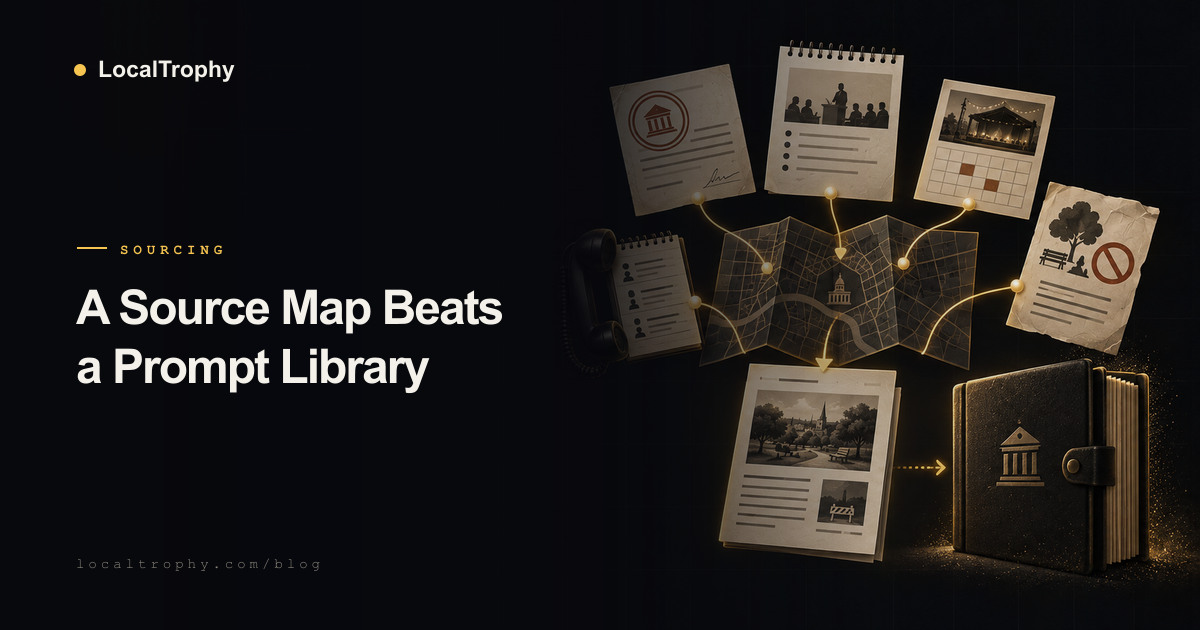
This distinction has become fuzzy during the AI boom. Prompts are easy to collect, easy to share, and easy to admire without publishing anything. A source map is less glamorous. It contains permit feeds, meeting agendas, event calendars, venue pages, neighborhood groups, and people who know what the official page forgot.
One gives you recurring local information. The other gives you 14 ways to ask a model for "engaging content ideas."
Build the source map first.
A prompt cannot recover what nobody collected
Ask a model for ten things happening in your city this week and it may produce a plausible list. Some items will be current. Some will be old. Some will be the same obvious events every other publisher found. The prose can be excellent while the reporting layer is absent.
The model does not know which permit was filed yesterday, which trailhead closed for construction, or which venue changed its Friday rules unless those facts entered the system. No clever prompt can summon a city council attachment that nobody opened.
The defensible advantage in local publishing is not access to text generation. Everybody has that. It is knowing where useful changes appear before they have been flattened into the same roundup.
That is why local newsletter content ideas should begin with sources, not blank-page brainstorming. Ideas appear when recurring signals meet: a permit near a familiar storefront, an agenda item beside an old promise, an event rule that changes how families should plan the night.
Give each source a job
A source map should not be a giant bookmark folder called "research."
Start with civic operations. Permit databases can show where work is proposed. Meeting agendas reveal what public bodies will discuss before the recap appears. Planning documents, bid notices, road closures, and parks updates each produce facts with different lead times.
St. Petersburg, for example, exposes permit records through a public city data service. That does not turn each record into a story. It gives a publisher a recurring place to look for change, then verify what the filing actually means.
Add public-life sources. Libraries, museums, neighborhood associations, schools, recreation departments, arts groups, and venue calendars tell you what residents can attend. Social accounts may be easier to scan, but first-party pages are usually better for checking time, cost, access, and cancellation terms.
Add commercial signals. Business filings, liquor-license notices, leasing announcements, job posts, and construction permits can suggest openings before the sign goes up. Treat them as leads. A permit for restaurant work does not mean the restaurant opens Friday, however nicely that would complete the issue.
Then map human sources. Owners, organizers, librarians, coaches, neighborhood regulars, and city staff can explain what a database cannot. Record the subjects they know and how they prefer to be contacted. Do not turn people into a cheerful little CRM of local gossip.
Record how the source fails
Every source decays differently.
A city agenda appears on a schedule. A museum collection page may change slowly, while its events calendar can become wrong within hours. A neighborhood post may be early and useful but require aggressive confirmation. Scottsdale's preserve pages separate trailheads by amenities and publish changing hours and closures. The stable description and the current access information do not deserve the same review cadence.
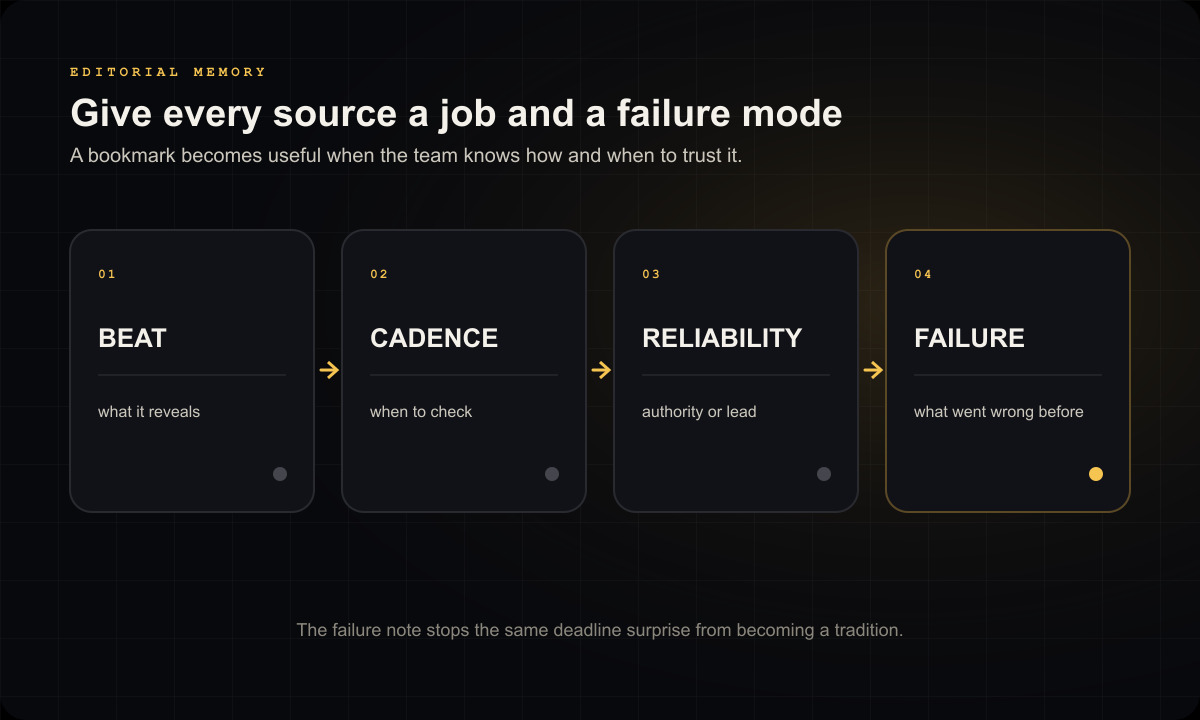
For each source, record:
What it covers
How often you plan to check it
When it was last checked
Whether it is authoritative, suggestive, or merely interesting
Which facts require a second source
What has gone wrong before
That final field saves real time. A venue may leave sold-out events online. A city feed may show application dates rather than approval dates. A calendar may place the series time on each event. Without notes, the newsletter gets to rediscover these quirks under deadline forever.
A source map turns those lessons into editorial memory.
Use AI after retrieval, not instead of it
AI becomes useful once the material exists.
It can compare this week's agenda with last month's, cluster permits by neighborhood, extract dates from a dreadful PDF, flag duplicate events, and propose questions for an organizer. A small team can inspect a larger portion of the city without asking a person to read every page line by line.
Retrieval and verification remain separate jobs. The model can summarize what a page says. It cannot guarantee the page is current or that a permit means what the draft claims. Keep the original link, retrieval date, exact claim, and verification status beside the working note.
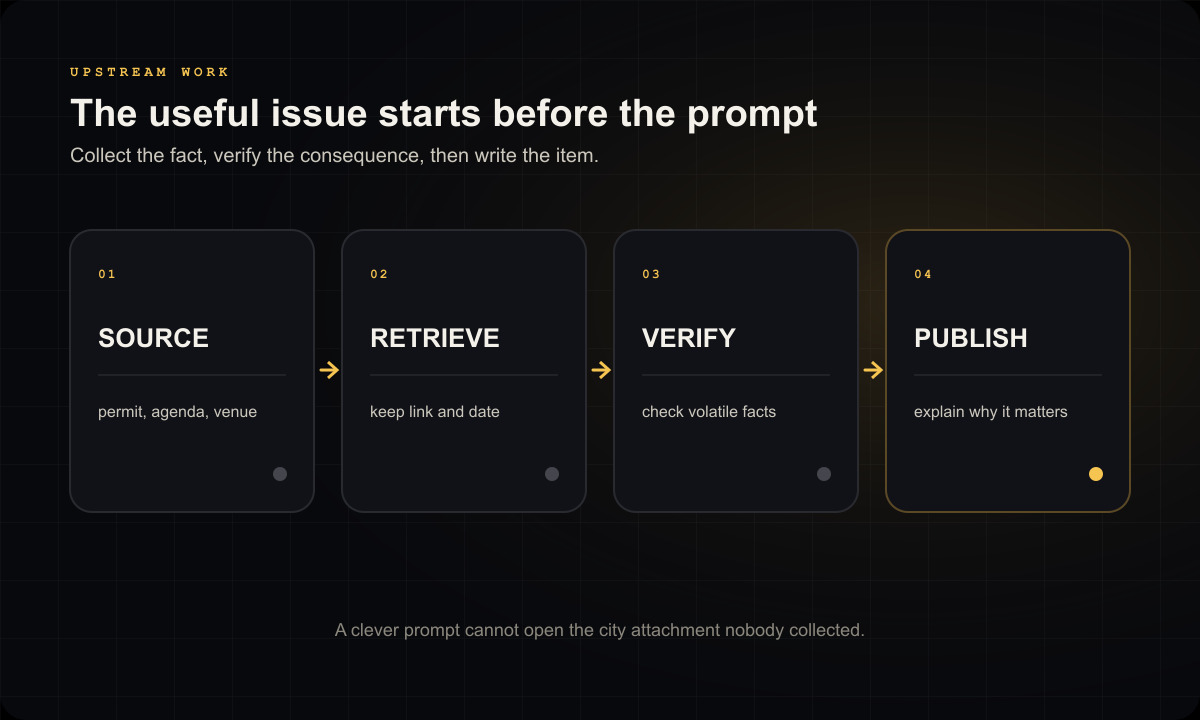
That discipline helps the publication improve. When one section consistently earns replies or clicks, you know which source family feeds it. You can deepen that reporting loop instead of generating another batch of disconnected ideas. Growing a local newsletter gets easier when the publication has a repeatable information advantage rather than a weekly inspiration emergency.
Start with twenty useful places to look
You do not need 300 sources before the first send. Start with roughly twenty that cover different parts of local life. The number is a practical starting point, not a civic completeness score.
Choose several civic sources, reliable event and venue sources, commercial-change signals, and a short list of people. Run them for four issues. Track which sources produce items readers use and which produce noise. Add a source to fill a visible gap, not because somebody posted an enormous directory online.
The map should support recurring sections: an openings watch, a weekend plan, one public decision worth understanding, perhaps a strange local item that would never appear in a generic feed. If no source supports a section reliably, improve the map or retire the section.
This becomes a business asset. Sponsors value a publication that understands its community and arrives consistently. Readers recommend the issue that catches a useful change early. Local newsletter monetization follows trust more readily than it follows prompt sophistication.
FAQ
What is a source map for a local newsletter?
It is a maintained list of public and human sources, organized by what each source reveals, how often it changes, how reliable it is, and how its information should be verified.
Should I use AI to monitor local sources?
Yes, especially for comparison, extraction, clustering, and first-pass summaries. Keep the original links and verify claims that affect a reader's plans, money, safety, or understanding of a public decision.
How often should I update the map?
Check high-change sources for each issue. Review the map monthly, then do a deeper quarterly cleanup for dead links, weak sources, and missing parts of the city.
LocalTrophy can help turn that source map into a newsletter people want to open. The prompt library may remain in its folder, where it will continue looking extremely organized.